
Before you sign or pay anything, you should verify the landlord’s authority through county records and confirm any manager’s written authorization, then pay only by traceable method. You should inspect the unit for leaks, pests, working locks, and tested smoke/CO alarms, and run faucets and toilets. You should document condition with date-stamped photos and a move-in checklist. You should total all fees, utilities, and parking, and confirm pet, guest, sublet, entry, repair, disclosure, and deposit terms in writing. Keep going to see a fuller checklist.
Key Takeaways
- Verify the landlord’s authority via county records, ID, and written management authorization before paying any fees or deposits.
- Inspect the unit for leaks, pests, working locks/windows, and functioning smoke and carbon monoxide alarms.
- Document condition with date-stamped photos/videos and a signed move-in checklist noting preexisting damage and missing items.
- Read lease rules on pets, guests, subletting, quiet hours, and fees; ensure every promise or exception is in writing.
- Confirm entry notice, habitability and repair duties, required disclosures, and security-deposit return deadlines, deductions, and move-out procedures.
Confirm the Landlord Is Real (Before You Rent)

Before you send any money or sign anything, how do you confirm the “landlord” actually has legal authority to rent you the property? Start by checking county property records to match the owner’s name to the person demanding payment.
If a manager claims authority, require a signed management agreement or notarized authorization, and verify it with the recorded owner using independently sourced contact details.
Demand government ID and confirm consistency with the deed, tax bill, and utility billing name.
Use a traceable payment method; refuse cash, wire transfers, or “application fees” paid before verification.
Conduct Landlord background checks for prior fraud judgments, evictions, or liens.
Request Rental history verification by asking for prior tenant references and cross-checking addresses and dates.
Keep screenshots, emails, and receipts.
Tour Like a Renter: Damage, Pests, Safety Checks
Even if the unit looks clean at first glance, you should tour it like you’re building an evidence file: inspect for water damage (stains, soft drywall, warped baseboards), active leaks (under sinks, around toilets, at the water heater), and signs of pests (droppings, shed wings, bait stations, musty odors, gaps around pipes).
Test every window and lock, confirm deadbolts engage, and check that exterior doors close square. Verify smoke and carbon monoxide alarms exist where required; ask when they were last tested.
Turn on faucets, flush toilets, and run the shower to check pressure and drainage. Look for exposed wiring, loose outlets, and tripped breakers.
Walk common areas for lighting and secure entry. Consider neighborhood amenities and confirm local zoning won’t undermine quiet enjoyment.
Document Condition With Photos and a Move-In Checklist
Before you take possession, you’ll create dated, high-resolution photos and video of every room, fixture, appliance, and any existing damage, and you’ll store copies in a backed-up location.
You’ll complete a move-in checklist item by item, noting stains, scratches, odors, pest signs, and any missing or nonworking features.
You’ll require the landlord’s written acknowledgment.
You won’t rely on memory or verbal assurances because this record helps limit disputes over responsibility and your security deposit.
Photo Evidence Essentials
Although a walkthrough feels routine, you should treat move-in documentation as evidence that can determine whether you recover your security deposit. Take date-stamped photos and short videos before you move belongings in, capturing wide shots and close-ups.
Photograph floors, walls, ceilings, windows, appliances, fixtures, smoke detectors, and any existing stains, chips, rust, or water marks. Include serial numbers and utility meter readings if accessible.
Store originals in a secure cloud folder and don’t edit files; preserve metadata for authenticity. Send copies to the landlord by email and request written acknowledgment.
While doing so, respect Tenant privacy by avoiding images of neighbors, mail, or personal data. Keep the record for the full tenancy and through Lease renewal negotiations, disputes, and move-out.
Move-In Checklist Details
Once you receive the keys, complete a written move-in checklist that matches the unit’s condition room by room, and tie each entry to supporting, date-stamped photos.
Note preexisting damage, cleanliness issues, and missing items: floors, walls, ceilings, windows, screens, locks, appliances, plumbing, HVAC, smoke/CO detectors, and fixtures.
Record meter readings and provided keys, fobs, and parking permits.
Use clear, objective wording (“2-inch chip, left of sink”), not opinions.
Send the checklist and photos to the landlord within the deadline stated in your lease agreements, and keep proof of delivery.
Ask for written acknowledgment or corrections.
Store originals securely, and back up copies.
Confirm how the checklist affects security-deposit deductions.
Even with Rental insurance, treat documentation as essential to dispute liability for prior conditions.
Calculate True Monthly Costs (Fees, Utilities, Parking)

You should itemize every mandatory fee in writing (e.g., application, admin, amenity, trash, pest control) and confirm when it’s due and whether it’s refundable.
You should also estimate utility expenses by identifying which services you must place in your name, reviewing typical usage costs, and noting any billing method (submetering or flat-rate) that could vary month to month.
You should assess parking costs by verifying whether a space is included, the monthly rate for assigned or guest parking, and any penalties or towing terms that could create unexpected charges.
Itemize Mandatory Fees
Before signing a lease, itemize every mandatory charge so the advertised rent doesn’t obscure your true monthly cost. In your renting paperwork, demand a written fee schedule that matches the lease terms, not verbal promises.
Confirm all recurring charges: application or screening fees, amenity or “resident benefit” packages, pest control, trash/valet service, administrative fees, insurance surcharges, and monthly pet rent.
Identify one-time costs: deposits, move-in fees, key/fob charges, and lease preparation fees.
If parking is required, verify the exact monthly rate, space assignment, guest rules, and towing authority.
Check escalation clauses, proration methods, and billing dates.
Require receipts and dispute procedures, and don’t sign until every “mandatory” item appears in writing.
Estimate Utility Expenses
Although the advertised rent may look fixed, utilities can shift your actual monthly obligation substantially, so quantify them in writing and treat any estimate as a risk factor until verified.
Require the landlord to specify, in the lease or an addendum, which utilities you must pay (electric, gas, water, sewer, trash, internet), who bills them, and whether charges are submetered or allocated by formula.
Request the last 12 months’ average and peak bills for your unit or a comparable unit, and document any refusal.
Confirm whether HVAC, hot water, and laundry are electric or gas and whether rates vary seasonally.
Add these figures to mandatory fees to test rent affordability over the full lease duration, and budget a conservative buffer for spikes and rate changes.
Assess Parking Costs
Where will the vehicle actually go, and what’ll it cost per month after every add-on? Confirm whether parking is included in rent or billed separately. Request written disclosure of all parking fees: assigned space charges, garage rent, tandem premiums, guest passes, and remote fob deposits. Verify whether the fee is fixed, month-to-month, or subject to unilateral increases, and require notice terms in the lease.
Review parking regulations for the building and municipality. Check permit requirements, towing authority, enforcement hours, and restrictions on vehicle size, commercial plates, EV charging, motorcycles, and overnight guests.
If you rely on street parking, confirm signage rules and ticket frequency. Document the space number, access method, and liability allocation for theft or damage. Don’t assume “free” means “available.”
Before You Sign: Pets, Guests, Subletting, Quiet Hours
Even if the rent looks right, you should treat the lease’s rules on pets, guests, subletting, and quiet hours as enforceable conditions that can trigger fees, default notices, or termination if you violate them.
Review Pet policies for species, size, number limits, pet rent, deposits, insurance requirements, and mandatory screening; confirm any “no pets” clause covers visiting animals and service/assistance-animal procedures.
Check Guest regulations for maximum overnight stays, registration requirements, parking limits, and when a guest becomes an unauthorized occupant.
For subletting or assignments, require written consent standards, application fees, and liability language; you may remain responsible for rent and damages.
Read quiet-hour clauses for time ranges, noise definitions, and complaint process; verify penalties are stated and proportionate.
Get all approvals in writing.
Know Your Rights: Entry Notice, Habitability, Disclosures
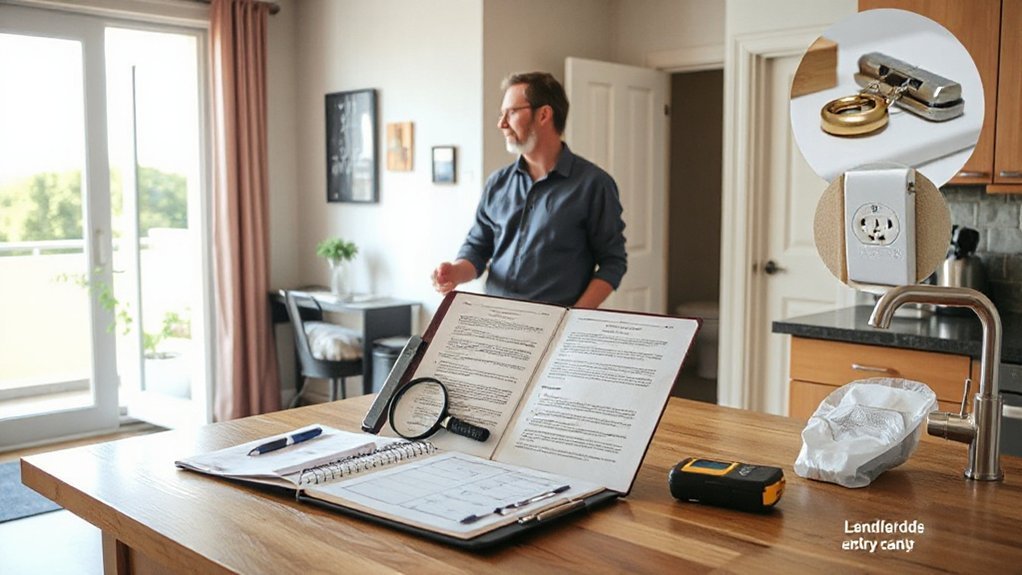
Before you move in, confirm the lease and local law protect three core rights: advance notice before the landlord enters, a habitable unit throughout the tenancy, and accurate written disclosures about the property.
Require an entry clause that limits access to defined purposes, sets minimum notice hours, and preserves Tenant privacy; insist on written notice and documentation for every non-emergency entry.
For habitability, verify the lease doesn’t waive statutory warranties and states the premises will meet health and safety codes at commencement and during occupancy, including utilities and security features.
Demand all mandatory disclosures in writing (lead paint, mold, flood risk, smoking rules, bed bugs, prior damage), and keep copies.
Confirm whether disclosure updates are required at Lease renewal and whether you must acknowledge receipt.
Repairs and Emergencies: Who Handles What, How Fast
After you’ve locked in entry limits, habitability standards, and required disclosures, put equal precision into the lease’s repair and emergency provisions so you’re not arguing about responsibility when something breaks.
Require a written allocation: landlord handles structural, plumbing, electrical, HVAC, and appliance failures; you handle minor upkeep only if narrowly defined.
Set response times: emergencies (no heat in winter, gas leak, flooding, electrical hazard) within hours; urgent repairs within 24–48 hours; non-urgent within a stated window.
Specify the reporting method, after-hours contact, and permission for you to call qualified vendors if the landlord can’t be reached, with capped reimbursement and documentation requirements.
Confirm liability limits for consequential damages.
During Lease renewal, guarantee repair duties don’t shift or trigger rent escalation.
Security Deposit and Move-Out: Deductions, Cleaning, Timing
Because deposit disputes usually turn on documentation and deadlines, you should spell out security-deposit handling and move-out procedures in the lease with the same specificity as rent and repairs.
Confirm the Security deposit amount, where it’s held, whether interest accrues, and the exact statutory return deadline.
Require an itemized statement for any deduction, limited to unpaid rent, documented damage beyond ordinary wear, and contractually defined cleaning.
Define “ordinary wear” and ““clean” (e.g., carpet shampooing only if professionally installed at move-in).
Schedule a pre–move out inspection with written findings and a cure period to remedy issues.
Take dated photos and keep receipts.
Specify key return, forwarding-address notice, and prorated rent rules.
State that deductions must be supported by invoices, not estimates.
Conclusion
Before you sign, stay skeptical and specific. Confirm the landlord’s identity, scrutinize the space, and record every crack, chip, and concern with photos and a move‑in checklist. Count the complete cost—fees, utilities, and parking—so surprises don’t surface later. Read rules on pets, people, and partial sublets. Know notice and habitability rights. Require repair routes and response times in writing. Secure clear deposit terms to limit deductions and delays.