
You’ll prevent damp in an older British property by first confirming the type: take repeat moisture readings (calibrated capacitance meter and, if needed, carbide testing) and match symptoms—tide marks and salts suggest rising damp, isolated patches suggest penetrating damp, mould and RH above 60% suggest condensation, and localised wetting can indicate leaks. Then fix the pathway: clear gutters, repair roofs/flashings, repoint with lime, lower external ground, improve drainage and sub-floor ventilation, and keep finishes breathable for compliance. Continue for step-by-step checks and remedies.
Key Takeaways
- Diagnose damp type with symptoms plus moisture profiling, using calibrated meters and confirmatory tests like carbide and salt analysis.
- Inspect exteriors: roofs, flashings, gutters, downpipes, pointing, render cracks, and window seals; ensure rainwater discharges correctly.
- Prevent rising damp by removing bridging, lowering external ground levels, improving drainage, and enhancing sub-floor ventilation before considering DPC works.
- Stop penetrating damp by repairing roofs and leadwork, repointing with breathable lime mortar, and clearing or realigning leaking gutters and downpipes.
- Reduce condensation by maintaining 40–60% indoor RH, using effective extraction and trickle vents, and keeping steady heating to avoid cold surfaces.
How to Tell What Type of Damp You Have
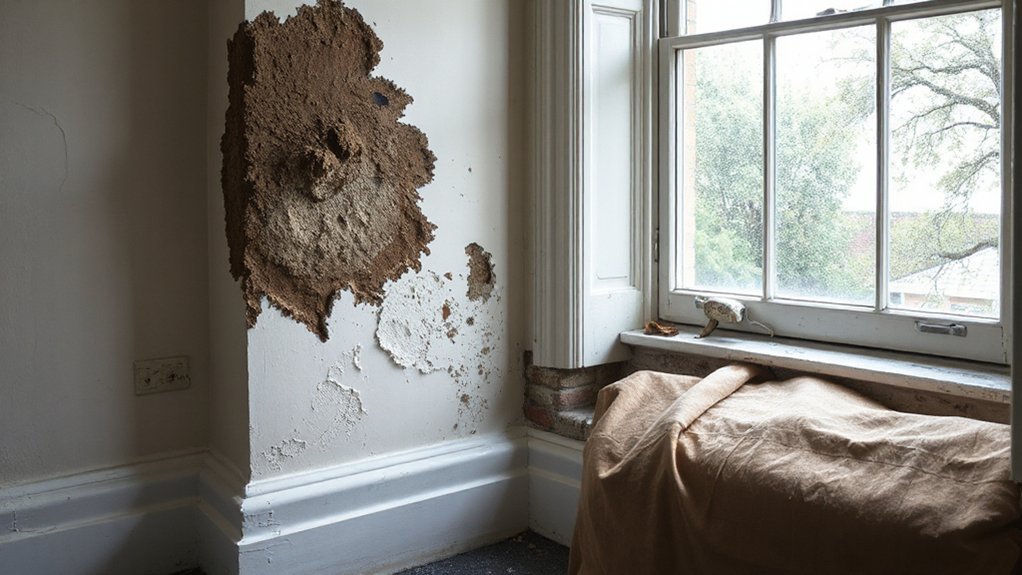
Before you choose a remedy, you need to confirm whether you’re dealing with rising damp, penetrating damp, condensation, or a plumbing leak, because each has distinct causes and compliance implications.
Start by mapping symptoms and measuring wall moisture with a calibrated capacitance meter, then verify with carbide (CM) testing where access allows.
Rising damp typically shows a low-level “tide mark,” hygroscopic salts, and paint deterioration up to about 1m.
Condensation presents as surface droplets, mould in corners, and peaks when indoor RH exceeds 60% without equivalent fabric wetting.
Plumbing leaks create localised, persistent damp, often with pressure-drop evidence or thermal anomalies.
Penetrating damp tends to correlate with wind-driven rain and isolated patches, but confirm with repeat readings over time to meet evidential standards.
Outside Checks for Damp in Period Homes
Although indoor symptoms often look convincing, you’ll get more defensible evidence by starting outside on a period home, where fabric defects and ground conditions usually explain moisture pathways.
Walk the elevations and note cracked render, open pointing, spalled brick, and failed seals around windows and service penetrations.
Check gutters, hoppers, and downpipes for leaks, misalignment, and overflowing at joints; confirm discharge reaches a gully, not the wall base.
Inspect roof coverings, flashings, and parapets for slipped units and defective leadwork.
Assess External paint: blistering and peeling can indicate trapped moisture or poor vapour permeability.
Review ground levels, hardstanding, and garden drainage; you should see falls away from walls, clear channels, and no ponding.
Record findings with photos for survey compliance.
Rising Damp in Old Houses: Causes and Fixes
You’ll typically see rising damp in old houses when the damp-proof course is missing, bridged, or failed, or when high external ground levels and defective drainage drive moisture up porous masonry by capillary action.
You should confirm the diagnosis with moisture profiling and salt analysis to distinguish it from condensation or penetrating damp. Then, align remedial work with relevant British Standards and good practice.
You can then fix it by lowering external ground levels, removing bridging, improving sub-floor ventilation and drainage, and installing a compliant DPC system where justified, followed by salt-resistant replastering.
Common Causes Of Rising Damp
When moisture from the ground can’t be blocked or diverted, it rises through masonry by capillary action and shows up as “tide marks,” crumbling skirtings, and salt contamination at low level.
You’ll usually trigger it where the damp-proof course is missing, bridged, or compromised: pre-1875 walls without a DPC; later repairs that cover it with render, insulation, decking, or raised paths; or internal plaster that continues below floor level.
You also increase risk when external ground sits too high against the wall, or when cavity walls contain debris that transfers water across.
In Historical building preservation, you must verify materials and detailing before altering breathability.
Poor Interior moisture control can mask diagnosis by elevating hygroscopic salts’ readings on meters.
Effective Fixes For Rising Damp
Rising damp fixes start by proving the moisture source and removing the defect that lets ground water wick up the wall, not by masking symptoms with tanking or “waterproof” paints. Confirm diagnosis with hygrometer profiles, salt analysis, and inspection of DPC continuity per BS 6576, ruling out condensation and leaks.
Lower external ground levels to at least 150 mm below the DPC, clear bridged cavities, and replace hard cement renders with breathable lime where appropriate for Historical preservation. Repair or install a compliant damp-proof course (chemical injection or physical DPC) only after you’ve removed bridging; otherwise it’ll fail.
Improve sub-floor ventilation and reinstate air bricks to control moisture load. Use compatible internal finishes and capillary-break moisture barriers at floors, not impermeable wall coatings. Document works for Building Control and conservation officers.
Penetrating Damp: Roofs, Walls, Gutters, Windows
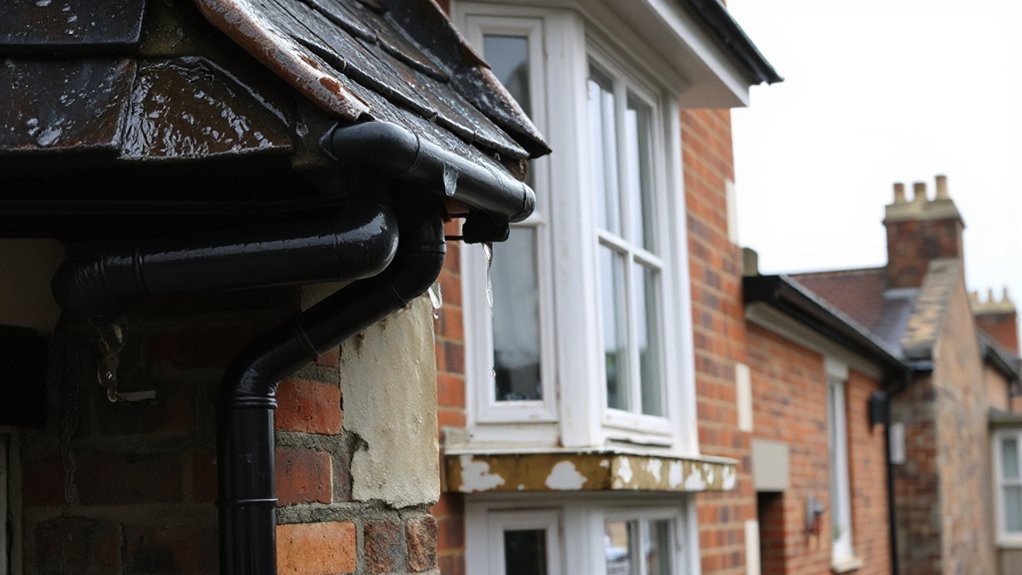
Penetrating damp occurs where rainwater breaches the external envelope—typically via defective roof coverings, porous masonry, failed pointing, blocked or leaking gutters/downpipes, and poorly sealed windows. It then migrates through the fabric by gravity and capillary action. You’ll confirm it by correlating staining patterns with rainfall, checking moisture profiles, and inspecting junctions, flashings, valleys, and parapets to BS 5534 principles.
Repair roofs with compatible slates/tiles and sound leadwork to BS EN 12588, then reinstate underlay laps and ventilation paths without altering the Historical interior.
On walls, you should repoint with lime where the original Building material requires permeability; avoid hard cement that drives moisture inward.
Clear, realign, and test gutters/downpipes; guarantee correct falls and sealed joints. Reseal window frames, repair sills, and maintain drip details.
Condensation Damp: Ventilation and Heating Fixes
Condensation damp can look like rain ingress, but it’s driven by internal moisture meeting cold surfaces, so you’ll treat the building’s ventilation and heat balance rather than its external envelope.
You’ll confirm with hygrometer readings (aim 40–60% RH) and surface temperatures; persistent mould indicates poor Indoor air quality.
Improve extract ventilation to meet Building Regulations Part F: fit humidistat-controlled fans in kitchens and bathrooms, ducted to outside, and keep trickle vents open.
If background airflow is low, specify whole-house mechanical ventilation where feasible.
For Humidity control, cover pans, vent tumble dryers, and dry clothes with extraction running.
Heat consistently to reduce cold spots: maintain steady setpoints, use timed thermostats/TRVs, and avoid intermittent “blast heating” that spikes RH.
Breathable Damp-Proofing Upgrades for Older Properties
Because many pre‑1919 homes were built to “breathe” through lime mortars, porous brick, and suspended floors, you’ll often make damp worse if you retrofit impermeable barriers that trap moisture and drive salts to the surface. Specify vapour‑permeable repairs: repoint in NHL lime, replace cement renders with lime render, and redecorate with mineral or limewash paints.
Improve subfloor airflow by clearing airbricks and maintaining cross‑ventilation; don’t block vents with insulation. Where you need a DPC, choose breathable systems (e.g., silane/siloxane cream) only after moisture profiling and salts analysis, and follow BS 6576 and BS 5250.
For Heritage preservation, you’ll document significance, use reversible methods, and match finishes for aesthetic considerations. Use competent contractors and keep test results.
Conclusion
If you ignore damp in an older British property, it won’t “settle down”—it’ll spread like it owns the place, undermining timbers, salts, plaster, and indoor air quality. You’ll stop guessing once you’ve identified rising, penetrating, or condensation damp with systematic checks and moisture measurements. Then you’ll fix causes: drainage, fabric defects, ventilation, and heat balance—using breathable, heritage-compatible materials. Follow manufacturer specs, Building Regulations, and conservation guidance, and you’ll keep the building dry for decades.