
Check whether low pressure hits one fixture or the whole house by testing hot and cold at several taps, then confirm with a hose-bibb gauge (aim 40–60 psi). If it’s isolated, remove and clean the faucet aerator or showerhead screen with vinegar and flush debris. For tub/showers, strong tub flow but weak shower points to a worn diverter. If it’s everywhere, verify valves are fully open, inspect supply lines, and check the PRV. More steps follow.
Key Takeaways
- Test hot and cold at several fixtures to see if low pressure is localized or affects the whole house.
- Measure static and running pressure with a hose-bibb gauge; aim for 40–60 psi and note drops under flow.
- Fully open main shutoff, meter valve, and under-sink angle stops; replace kinked or collapsed supply lines.
- Clean or replace faucet aerators and showerhead screens by removing debris and soaking parts in white vinegar.
- If pressure is low everywhere, check/adjust the PRV and look for leaks using the water meter; call a plumber for hidden leaks.
Diagnose Low Water Pressure: One Fixture or Whole House
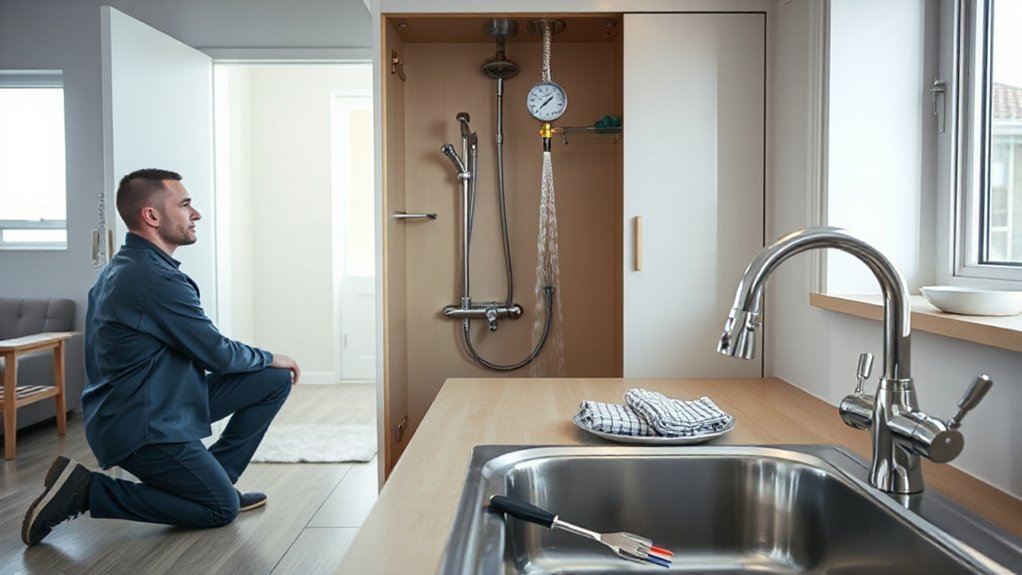
Before you start adjusting valves or swapping parts, confirm whether the pressure drop affects one fixture or the whole house. Check both hot and cold at several taps, then compare showers, kitchen, and outdoor hose bibbs to isolate zones.
For Water pressure testing, thread a gauge onto a hose bibb or laundry tap and record static pressure, then open a fixture to note dynamic pressure. Most homes target 40–60 psi per common code guidance.
If readings are low everywhere, verify the main shutoff and meter valve are fully open and look for recent utility work.
If pressure is normal at the gauge but weak at distant branches, prioritize Pipe corrosion detection: inspect exposed galvanized runs, discoloration, pinhole leaks, or debris at shutoffs.
Fix Low Water Pressure at Faucets (Aerators & Buildup)
Once you’ve confirmed the pressure drop shows up at a specific faucet rather than the whole house, start with the simplest restriction point: the aerator or faucet outlet.
Shut off the faucet, close the drain, and use padded pliers to remove the aerator without damaging the finish. Inspect the screen for debris and mineral buildup; note whether flow improves with the aerator removed (briefly run water to test, controlling splash).
Perform aerator cleaning by soaking parts in white vinegar, then brushing and rinsing. Replace cracked screens or missing O-rings to prevent leaks.
If the faucet has a concealed outlet, follow the manufacturer’s instructions and don’t exceed torque.
Restore service, verify steady flow on hot and cold, and recheck for drips.
Fix Low Water Pressure in the Shower (Head, Restrictor, Diverter)
If the low pressure shows up mainly in the shower, isolate whether the restriction sits at the showerhead, the flow restrictor, or the tub/shower diverter.
Start by turning off the shower, then cover the drain so small parts can’t fall in. Unscrew the shower head and check the inlet screen for grit or scale; flush it and soak parts in vinegar if allowed by the manufacturer.
If spray is still weak, look for flow restrictors inside the head or connector; remove only if your local code permits, since many jurisdictions require them for water efficiency.
For tub/shower combos, run the tub spout: strong tub flow but weak shower points to a worn diverter. Replace the diverter assembly or spout per listed parts.
Check Shutoff Valves, Supply Lines, and the Pressure Regulator
Low pressure that isn’t confined to a single fixture usually traces back to a partially closed shutoff, a kinked or clogged supply line, or a misadjusted pressure-reducing valve (PRV).
Start with Valve maintenance: confirm the main valve and all branch shutoffs are fully open, then check under-sink angle stops for seized stems or debris. Inspect braided connectors for sharp bends, crushing, or internal liner collapse, and replace any damaged line with the correct rated length and washers.
Next, do Pressure testing with a threaded gauge at a hose bibb or laundry tap; most systems should read roughly 40–80 psi. If pressure is low everywhere, inspect the PRV direction arrow and screen, then adjust per manufacturer instructions, in small increments, without exceeding code limits.
Find Hidden Leaks and Know When to Call a Plumber
Because a concealed leak can mimic system-wide pressure loss, you should rule it out before you keep adjusting valves or the PRV.
Start with Leak detection: shut off all fixtures, then watch the water meter; if the dial moves, you’ve got flow somewhere. Check under sinks, behind toilets, at the water heater, and along exposed piping for corrosion, staining, or damp insulation. Listen for hissing in walls and note warm spots on slabs.
Don’t ignore a running toilet; it can drop pressure at other taps.
For Plumbing maintenance, replace failed supply lines and repair dripping stop valves promptly.
Call a licensed plumber if you suspect a slab leak, hidden piping failure, gas water heater issues, or any code-required repairs.
Conclusion
Low water pressure won’t fix itself, but you can. You diagnose whether it’s one fixture or the whole house, you clean aerators and flush buildup, you service the showerhead, restrictor, and diverter, and you confirm shutoffs, supply lines, and the pressure regulator are fully open and set within code. You listen for leaks, you watch the meter, you document changes. If pressure stays unsafe or pipes show damage, you call a licensed plumber.