
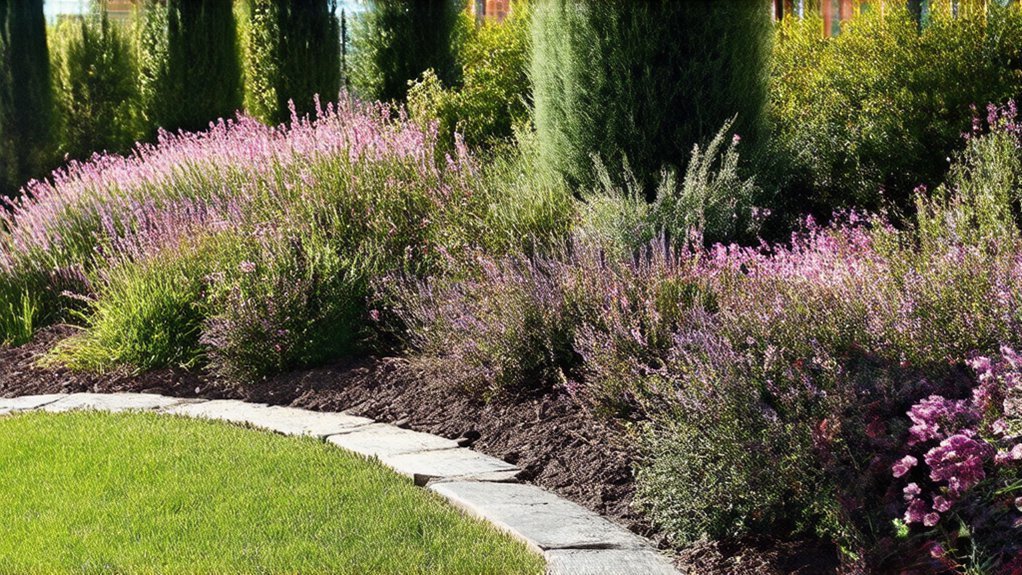
Garden Border Ideas: Mixing Perennials, Evergreens and Structural Plants
Start by mapping sun/shade and testing soil drainage, pH, and fertility, then measure your border for access and scale. Choose a clear style and a tight colour palette. Anchor the design with long-lived evergreens in layered tiers, spacing them for mature width. Add structural silhouettes (globes, columns, fans) to mark corners and curves. Layer perennials in 2–3 height bands and repeat key plants every 1.5–3 m for rhythm and season-long bloom. Next, you’ll see how to fine-tune combinations and winter structure.
Key Takeaways
- Assess sun, shade, and soil drainage first, then plan border depth, access, and sightlines to match plant choices and layout.
- Build a backbone with long-lived evergreens in layered tiers, spaced for mature size and varied textures to prevent congestion.
- Add structural plants with strong silhouettes to anchor corners and curves, creating rhythm through repeated forms and intentional pruning.
- Layer perennials in 2–3 height tiers, using repeated drifts with staggered bloom times for continuous color and minimal bare soil.
- Design for winter by keeping evergreen volume, seed heads, and woody stems visible, supported by clean edging, mulching, and selective staking.
Assess Sun, Shade, Soil, and Border Size
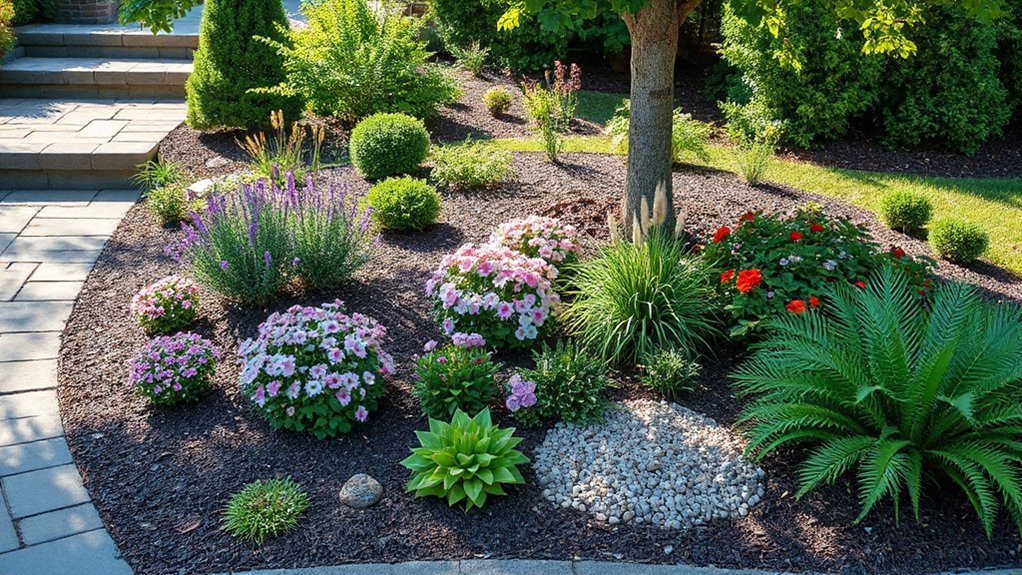
Before you choose plants or edging, evaluate the site conditions that will control how your border performs: map daily sun and shade patterns, identify soil texture and drainage, and confirm pH and fertility with a simple test.
Record hours of direct light at key points; buildings and trees shift exposure seasonally, so note winter and summer differences.
Check Soil drainage by digging a 30 cm hole, filling it twice, and timing infiltration; slow percolation flags compaction or a perched water table.
Assess structure with a hand-texture test and look for rooting depth limits.
Measure border length, depth, and access routes so you can stage plants, tools, and irrigation.
Finally, list microclimates and required shade tolerance zones so selections won’t fail under canopy drip or reflected heat.
Choose a Garden Border Style and Colour Palette
Next, you’ll define your garden border style—formal and geometric, relaxed and cottage-like, or modern and minimal—to set plant structure and edging requirements.
Then you’ll select a harmonious colour palette by choosing a dominant hue, 1–2 supporting colours, and a consistent foliage tone to control contrast and seasonal continuity.
With these parameters fixed, you can specify plant mixes that meet your site conditions while delivering a cohesive visual outcome.
Define Border Style
How do you want your border to read from the house and along the path—formal and architectural, or loose and naturalistic? Start by mapping sightlines and circulation: the style must support how you move and where you pause.
For a formal scheme, you’ll use repeated forms, clipped evergreens, and strong verticals, backed by crisp garden edge design (steel, brick, or cut turf) to hold geometry.
For a naturalistic scheme, you’ll mass perennials in drifts, soften transitions, and let structural plants punctuate rather than dominate.
Audit constraints next: boundary length, sun/shade bands, and viewing distance. Then choose Border style variations by setting a rhythm—modules, repeated anchor plants, and predictable height steps from front to back.
Select Harmonious Color Palette
Although your border style sets the structure, your colour palette controls legibility from key viewpoints and determines whether the planting reads as calm, energetic, or cohesive. Start by evaluating backdrop and light: cool hues recede in shade, warm hues advance in sun. Limit your core scheme to two to three dominant colours plus one accent to maintain Color harmony across seasons.
Use plant pairing to control transitions. Pair repeatable evergreen forms with perennials in adjacent tones, then punctuate with structural plants in high-contrast colours at focal nodes. Manage value (light/dark) as carefully as hue; strong value contrast improves visibility from doors, paths, and windows.
Finally, map bloom sequence so the palette doesn’t swing abruptly between months—swap in foliage colour, berries, and stems to keep continuity and reduce maintenance decisions.
Use Evergreens as Your Garden Border Backbone
Start by selecting evergreen anchor plants that match your border’s mature height, spread, and light conditions, so you lock in year-round structure.
Then layer additional evergreens in staggered tiers—tall to low and coarse to fine texture—to build depth and controlled visual rhythm.
You’ll get a stable backbone that keeps the border readable in every season while supporting seasonal perennials and annual accents.
Choose Evergreen Anchor Plants
When you build your border around evergreen anchor plants, you lock in year-round structure and reduce the “empty season” problem in winter.
Start with Evergreen selection based on mature size, growth rate, and site limits (light, soil texture, drainage, and wind). Choose one or two long-lived, low-maintenance forms—compact conifers, clipped box, yew, or holly—so you don’t overcomplicate pruning cycles or create crowding later.
Apply Border planting techniques that prioritize stability: set anchors first, align them with key sightlines, and space for full canopy width plus maintenance access.
Plant slightly high in heavy soil, firm the rootball, and mulch without burying stems.
Add irrigation for the first two seasons to secure establishment and color retention.
Layer Evergreens For Depth
Evergreen anchor plants give your border fixed points, but you’ll get a fuller, more professional look by building a layered evergreen backbone between and around those anchors. Start with mid-height shrubs (60–120 cm) to stitch gaps, then add low mounding evergreens (20–45 cm) at the front edge to soften lines and suppress weeds. Use upright forms sparingly to create rhythm and guide sightlines.
For reliable Evergreen layering, alternate leaf texture and tone: fine conifers behind broadleaf evergreens, dark greens beside variegates. Maintain clear spacing at maturity to prevent congestion and disease.
With Structural plant placement, keep the tallest masses on corners or behind focal perennials, then step down toward paths for clean access, consistent maintenance, and year-round depth.
Add Structural Plants to Shape the Garden Border
Although flowering perennials bring seasonal color, structural plants set the border’s framework so it reads as intentional year-round. Use Structural plant placement to establish fixed reference points: repeat clipped evergreens, architectural grasses, or upright yuccas at measured intervals to create rhythm and guide sightlines. Anchor corners, gates, and path junctions with one dominant form, then echo it to prevent visual drift.
Apply Border shaping techniques by choosing strong silhouettes—globes, columns, fans—and aligning them to the border edge you want to emphasize. Keep spacing proportional to mature width so forms don’t merge and lose definition.
If you’re working along a curve, stagger structural plants to reinforce the arc rather than fighting it. Maintain crisp outlines with selective pruning and consistent mulched negative space between anchors.
Layer Garden Border Heights From Front to Back
Structural anchors give your border fixed reference points; height layering then turns those points into a readable planting plan from every viewing angle. Set your tallest plants at the back (or center in island beds) to screen fences and frame focal elements, then step down in 2–3 clear tiers to the path edge.
Use a 60/30/10 height ratio: 60% mid-layer for seasonal bulk, 30% low layer for edging and access, 10% tall layer for vertical emphasis. Keep front plants under 30 cm to prevent sightline blockage; place mid-layer at 40–80 cm; reserve 100–180 cm for back layers.
Plan Wildflower combinations in the mid tier for texture, and specify Butterfly attractants near the viewing edge for monitoring and maintenance access.
Repeat Key Plants for a Cohesive Garden Border
When you repeat a small set of “key” plants at regular intervals, you create visual rhythm that ties the entire border together and makes the layered heights read as one intentional design.
Choose 2–4 anchor species: one structural evergreen, one upright accent, and one mid-mass filler, then place them every 1.5–3 m depending on mature spread.
Use consistent plant pairing each time (for example, the same grass beside the same shrub) so the eye recognizes patterns quickly.
Maintain border symmetry by mirroring placements across gates, paths, or focal points, even if you vary quantities for site constraints.
Keep spacing uniform, align repeats with utilities and irrigation zones, and cluster in odd numbers for legibility.
You’ll get cohesion without over-planting.
Pick Perennials for Season-Long Garden Border Colour
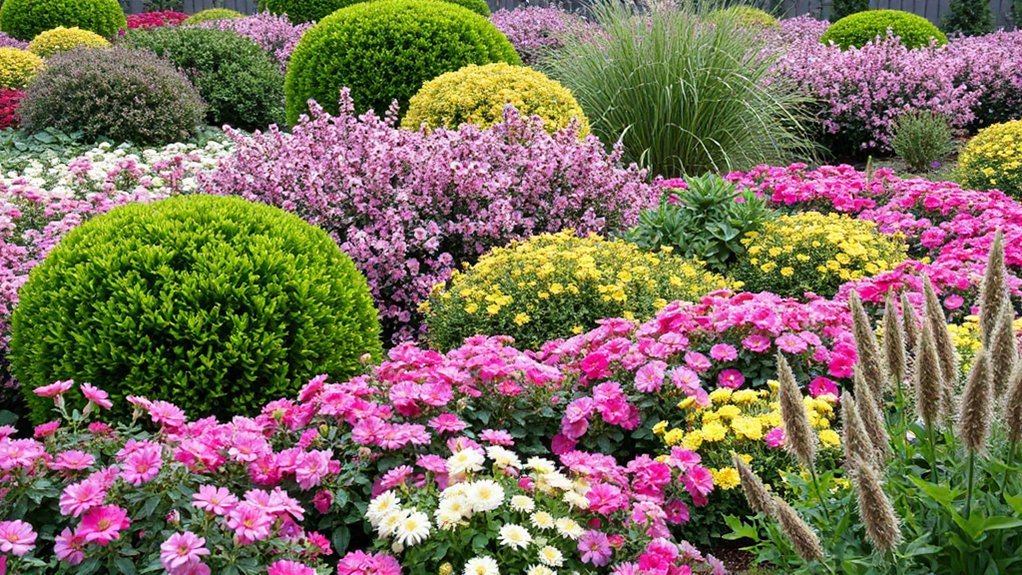
To keep a garden border in colour from spring through frost, you’ll need perennials that stagger their bloom times and hold strong foliage between flushes. Start with early performers like hellebores and pulmonaria, then bridge gaps with hardy geraniums, salvias, and catmint. Finish strong with echinacea, rudbeckia, asters, and sedums for late-season saturation.
Use Seasonal flower combinations by pairing complementary hues and repeating a few anchor colours every 3–5 feet. Apply border planting techniques: place taller bloomers mid-to-back, mass plants in odd-number drifts, and interlock clump-formers to reduce bare soil.
Prioritize cultivars with long bloom or reliable rebloom, and deadhead strategically to extend peak colour.
Keep Your Garden Border Strong in Winter
How do you keep a border looking intentional after the last blooms fade? You build a winter framework: evergreen volume, structural stems, and clean edging that reads as deliberate design even under Winter snow. Anchor your plan with compact conifers, clipped box alternatives, or evergreen grasses set at repeating intervals to maintain rhythm.
Next, specify frost resistant plants that hold form: hellebores, bergenia, carex, and sedum heads you leave standing. Add woody structure with dogwood, viburnum, or hydrangea for winter silhouettes.
Manage performance: cut back only what collapses, tie flopping stems, and mulch to stabilize root zones. Finally, confirm sightlines from key windows and paths so winter texture stays visible and balanced.
Conclusion
Now you’ve assessed light, soil, and scale, and you’ve locked in a palette that won’t fight itself. You’ve built your border on evergreens, added structural anchors, layered heights, and repeated key plants for visual continuity. Perennials then deliver controlled, season-long colour—without gaps. But don’t stop yet. The final test comes when temperatures drop: if your framework holds, your border still reads as designed. Get winter right, and everything clicks.…